

Face taping: what to use it for and how to use it

- 1 Face-lifting treatment
- 2 The application of the tapes in face-taping
- 3 Benefits
Face taping
Taping is most widely used in pain therapy and the medical field.
Coloured tape is a valuable ally of athletes and physiotherapists, ensuring an almost complete recovery from injuries or accidents. Yet its use is not limited to this.
For some years now, kinesio taping has also been applied on the face using a new technique, mainly used in the cosmetic field: face taping.
But what is it? And how is it applied? Dr. Maria Luisa Morelli, a leading expert in facial osteopathy, offers further insights.
What is face taping?
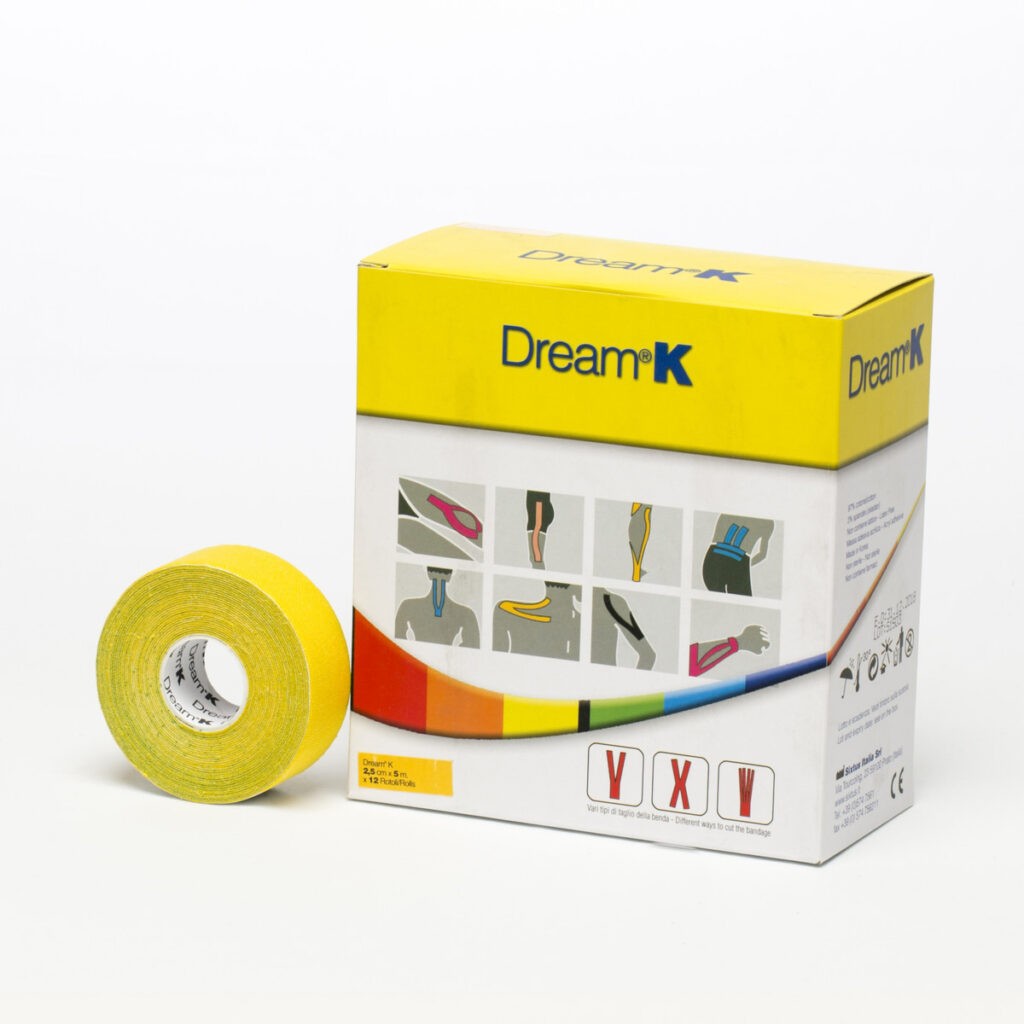
Face taping with Kinesio Tape is a non-invasive face-lifting treatment that uses special elastic adhesive tapes, the colour of which varies according to the degree of tension offered. Initially, these tapes were only used in medical sports and physiotherapy to provide neuromuscular and proprioceptive bandaging, making it a valuable support in the treatment of muscle microtrauma; one of its most significant benefits is the recovery of injured areas in pain therapy. It consists of a cotton and spandex support, with 140% extensibility to guarantee the movement of the muscles in the areas where it is applied; in fact, its application can produce micro-movements that stimulate the skin receptors, ensuring a reflex muscular response.
Choosing the tape’s degree of tension depends on the type of use a person wants to make of it. In the aesthetic field, the degree of extension will completely differ from the one used in therapy.
Kinesio Tape is used to combat wrinkles, puffiness, and dark circles under the eyes.
Thanks to the relaxing action of the tapes, the treatment promotes blood and lymphatic circulation, drains liquids, and tones the tissues, stretching the skin and reducing the signs of ageing. The incredible benefits it offers vary a lot on the area where it is applied.
How to apply face taping to the face
The application of the tapes in face-taping varies depending on the area of the face. Still, in general, their effect is to slightly lift the skin and reactivate the muscles, which are often contracted due to stress, causing wrinkles to form and the skin to lose tone.
Therefore, the effect obtained is that of a natural lifting, without surgery, which can be invasive.
The tape has a hypoallergenic structure with small waves that, once in contact with the skin, activate the muscles of the face to return it to a correct natural position.
We recommend aesthetic taping on clean, dry skin for at least 1 week to 10 days, especially at night before bed.
The tape should be left on overnight and then gently removed the next morning, holding the area where the taping is anchored. Its action is on the facial expression and circulation muscles, acting above all on the excess fluid in the skin and subcutis.
The application is straightforward.
After cleansing the face, the kinesio tape must be cut into specific shapes and adhered to the skin. It can be applied to various areas of the face based on the result one wants to obtain, such as the forehead, the eye area, around the lips, or on the neck.
The following day, it is removed by cleansing the face again and applying a moisturising cream.
Those who follow a skincare routine can integrate face taping into their routine.
But that’s not all. To increase the effects of kinesio taping, one can do some facial gymnastics in front of the mirror.
For example, one of the most common exercises is to contract the forehead muscles to the maximum and then open the eyes wide, raising the arch of the eyebrows with the fingers to create a slight state of tension.
This activity should be repeated 20 times before applying the tape.
Another exercise is to open the mouth, trying not to form wrinkles around it and staying in that position for 20 seconds.
What are the benefits of face-taping?
Say goodbye to puffiness and dark circles.
Face taping offers many benefits that can breathe new life into your face. For example, one of the benefits of face-taping is its anti-wrinkle effect, achieved by compressing the facial mimic muscles.
When applied, kinesio taping significantly reduces micro-movements during the night and relaxes the muscles; applying it every night for a week to 10 days, flattens wrinkles and reduces skin rippling.
But it doesn’t end there.
The tape application significantly reduces swelling in the face thanks to the draining and lymphatic effect it produces. For those who hate haematomas or dark circles under the eyes, kinesio taping comes to their rescue, pushing the lymphatic system to work and carrying away excess fluid and waste in the facial area.
The skin gets many benefits from this technique: nourishment and oxygenation.
Furthermore, there are no contraindications for the use of face-taping.
It is safe for any skin type and has no side effects.
On the contrary, it is particularly recommended for dry and dull skin to be combined with specific creams and serums.
However, it is good to prepare the affected area, mainly if the problem is caused by poor posture or stress.
The area must be decongested, and the muscles must relax before applying the tape. It is good to remember to always use a moisturising cream at the end of the treatment to leave the skin feeling moisturised and soft.